

Interdependence Day
Life, Liberty, and the Pursuit of Happiness

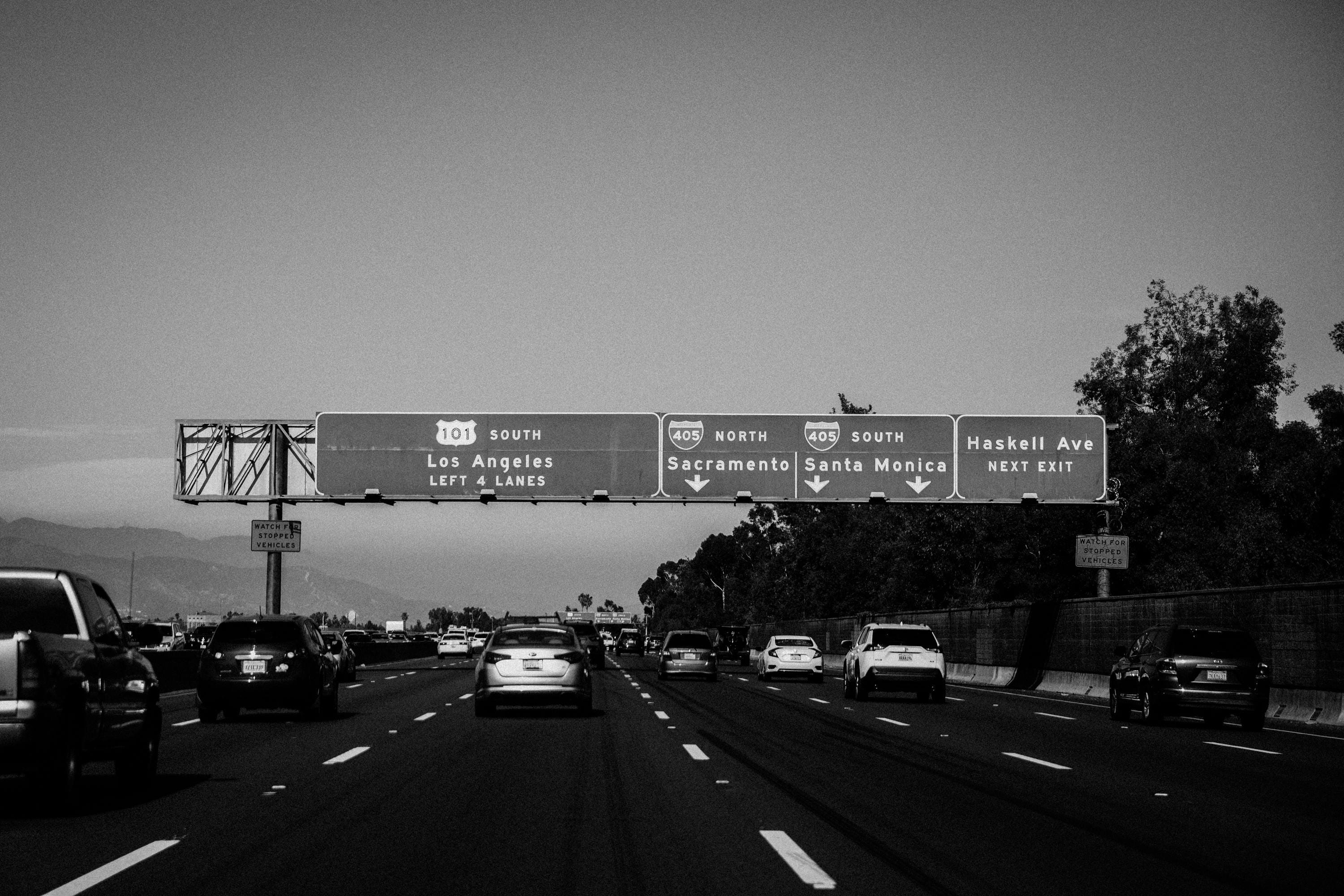
I am in my happy place, snug in the middle lane of the 101 coasting at a modest 60 miles per hour, listening to The Daily, driving to Topanga with Micah. Schuyler thinks I drive too slowly. I prefer “cautious.” It might be genetic.
My beloved Nana, barely 5 feet in heels, seldom broke 25 on the speedometer. As a young boy, I would often accompany her to her sacred weekly hairdresser appointment. There was a soda fountain there in which I enthusiastically indulged, creating madcap paper cup cocktails of Mr. Pibb and Fanta. Eventually, she’d emerge from the chair, grip my hand, her long, glossy red nails digging at my forearm skin, and lead me out to the mini-mall parking lot.
Automobiles did not spare steel in the 1970s. Nana would board her colossal Cadillac, often unwittingly parked askew across two spots, like a mouse saddling an elephant. She didn’t drive it as much as it drove her. She’d crawl out of the lot into traffic like a cruise liner leaving port, eyes peering out underneath the top curve of the wheel, nothing but her fabulous frosted red coiffure visible to leery fellow drivers. She would retell the same yarn of her father’s arrival at Ellis Island and then improvise with Ethel Merman schmaltz, “Only in America.” We’d stop to get Carvel. Heaven.
Generally, one podcast episode perfectly fills my commute to Topanga. Fourth of July weekend approaches, and the host is reciting our founding doctrine from our greatest piece of American literature. We know it almost too well, like a prayer uttered so many times that we forget its original meaning:
“We hold these truths to be self-evident, that all men are created equal, that they are endowed by their Creator, with certain inalienable rights, that among these are Life, Liberty and the pursuit of Happiness.”
This lofty, egalitarian ideal is the plotline of our national mythology. In its time, it was a radical repudiation of feudal European pre-destiny, where you were born either into the aristocracy or serfdom, and there you remained. This Declaration dispensed with the divine right of kings, ushered in the Enlightenment, and anointed individuals with the power to choose their own government.
Of course, we know this national folklore has been so often a fairytale, a false narrative. Just because these rights were scrawled on a parchment did not mean they came for free. Generation after generation, passionately engaged citizens have waged principled battles to better align our human condition with our most cherished principles. And, again, this call beckons.
When the framers penned the notion of all men as equal, they were certainly not drawing from evolutionary biology. A Darwinian understanding of the world was a century away, and of course, from a genetic perspective, we are all snowflakes. The concept of equality was based in the spiritual, specifically in the Judeo-Christian notion that every person is born with an eternal soul judged equally before God.
Yet, in the same stanza of this Declaration, there is a paradox. The spiritual notion of a land of equals striving for a common good echoed eleven years later in our Constitution by “We the people,” “a common defense,” “general welfare,” “more perfect union” and “United” states exists in stark contrast with inalienable individual entitlements. Life, liberty, and the pursuit of happiness have become increasingly applied to sanctifying the rights of the individual and protecting the ability to own property and amass material wealth. How we square our commonality and individualism has always engendered fierce national debate.
This tug of war between the common good and individual rights, often narrowly reserved for white, straight men and systematically denied to others, has been our messy national story. Slavery to abolition, Jim Crow to civil rights, codified patriarchy to women’s suffrage, discrimination to legalized gay marriage, we inch along, bumper-to-bumper, down the highway of the moral universe.
We have, from time to time, coalesced to dull the sharper edges of capitalism: a graduated income tax, social security, unemployment benefits, Medicare and Medicaid, student loans, and SNAP. And we have surfed waves of alternative community-based approaches to living, built on shared resources and distributed leadership.
But that sea has now flattened. And for a good fifty years, America has been dominated by unrepentant individual materialism. Unbridled capitalism, in cahoots with neo-liberalist government, has put its fat finger on the scale, tilting the balance between “we” and “I” so wickedly that, now, three people in the United States own more collective wealth than the bottom 50% combined. Of course, this grotesque inequity is the exact conundrum we set out to address in declaring our independence in the first place.
From the captain’s chair of my dusty vehicle, I reliably estimate that I can see a thousand cars of every conceivable color and size across this sprawling ten-lane superhighway. In front of me and behind, moving with me and against, there are tens of thousands more. Driving these sedans, pickup trucks, 18-wheelers, and minivans are operators of every color and creed, race and religion, class and orientation – moving as if under the direction of Esther Williams.
The Thruway is a poignant if prosaic portrait of a well-oiled social contract. We eschew certain rights to receive greater ones. With minor exceptions, we don’t drive 120 miles per hour, and in turn, we have the luxury of a road to travel on and a safe return home.
Road traffic serves as a rare alignment of self-interest and the common good. We drive mindfully, only as fast as the car in front of us. We brake when needed and let people merge in regardless of tint. The consequences of our autonomous actions are mutual. Recklessness results in a collective wreck. We may not share a destination, but we do share a meritocratic destiny. Nobody gets downtown before anyone else.
Here, on the Interstate, the intersection of shared humanity and self-preservation, the common good and individual rights, is in perfect and ordinary lockstep. Our individual freedoms are dependent on each other.
The past few years have supplied ample apocalyptic images of wildfire smoke — a potent reminder of our interconnectivity. The pall that last year engulfed New York and other cities of the Northeast drifted from hundreds of miles away. The desiccated brush and the drier, hotter weather that have led to longer and more intense fire seasons are not local creations. Biodiversity in the Sierras impacts temperatures in Des Moines. Carbon emitting from a tailpipe in Galveston affects sea levels in Fort Lauderdale. You simply cannot separate yourself and your circumstances from the greater human condition. We live within what Buddha called Indra’s Net, an interconnected web that at every intersection holds a droplet of water that reflects every other droplet.
Our greatest special challenges require humans to leverage their unique capacity to cooperate flexibly at scale. Our communal fate is in many ways reliant on billions of small, individual sacrifices. Again, we give up smaller freedoms in exchange for larger ones. For what kind of freedom exists when the air is so thick with smoke that you cannot go outside?
While patriotism has, over the past decade, too often donned the mask of nationalism and reeked of xenophobia… true patriotism is about sacrifice, doing your share such that a child you don’t know might have clean air and water, a good education, and decent health care.
In the end, there is both an irony and a beauty to the communal embrace of interdependence; a realization that our individual freedoms and the collective good are actually one and the same.
And perhaps our framers, despite their personal hypocrisies, were wise enough to comprehend this.
There is a spiritual lesson in this, and it’s not a novel one: The self is illusory. And this illusion, the notion that we are all distinct individuals living among other separate individuals in an external universe, is at the core of income inequality, racism, climate change, and just about every other source of human misery. Our ability to solve these existential riddles will stem from a collective spiritual revelation as much as political resolve.
I think about my Nana telling me stories in the car, fables of America, and the promise of its dream. I glance at Micah, wondering what stories I am going to tell her children’s children?
Today, paid subscribers receive exclusive access to my community chat, ad-free episodes of The Commune Podcast.
The podcast is where we explore the ideas and practices that help us live healthy, connected, and purpose-filled lives. Each week, I connect with teachers, spiritual leaders, scientists, doctors, and storytellers on topics such as food, health, philosophy, personal growth, environmental regeneration, and social wellbeing. Hope to see you there.
Share Your Own Stories
Have thoughts on the essays, or a story of your own? I’d love to hear it.
Send them over to jeffk@onecommune.com
Follow Along
Come find me on Instagram, Facebook, TikTok, and YouTube.
Listen to the Commune Podcast
Diaries of a Dance Dad Companion Episodes
🎧 You can also listen to The Commune Podcast, where I explore the ideas and practices that help us live healthy, connected, and purpose-filled lives. Each week, I connect with teachers, spiritual leaders, scientists, doctors, and storytellers on topics such as food, health, philosophy, personal growth, environmental regeneration, and social wellbeing. Or listen on Spotify or on Apple Podcasts.
Order the Audiobook
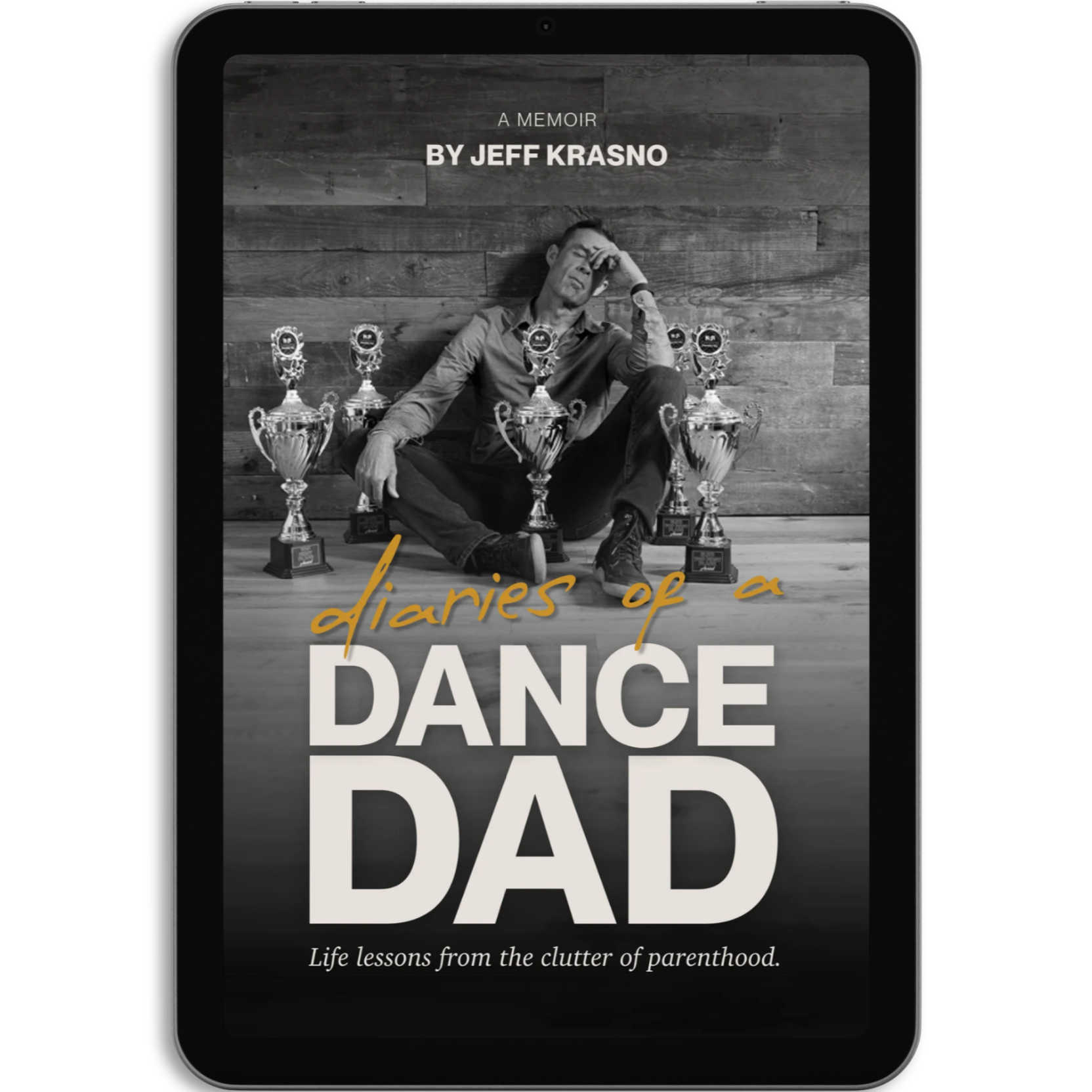
Order Diaries of a Dance Dad audiobook & hear the tales that bookend my paternal journey from cradle to empty nestdom.
Want to Go Deeper Into Your Mind-Body Alignment?
If today’s essay resonated, you’ll love my Cultivating Inner Peace course—available to all paid Substack subscribers. 10 powerfully simple meditations for navigating turbulent times.
👉 Become a paid subscriber to unlock the course and more.
If you’re already a paid subscriber, you can start the course!
Thanks for a great analogy of the need for shared effort to protect what we hold dear
The past 2 weeks my husband and I have driven from chagrin falls Ohio to San Diego - for our son’s wedding. We have witnessed first hand the dramatic economic disparity ( the poverty within the reservations vs the dripping wealth of golf club elites ), the undeniable climate effects ( fire and smoke kept us from hiking and breathing in multiple locations in Utah and Co)- extreme heat nationwide- AND the gorgeous landscape AND the gorgeous people AND a renewed felt sense of home in this paradox