


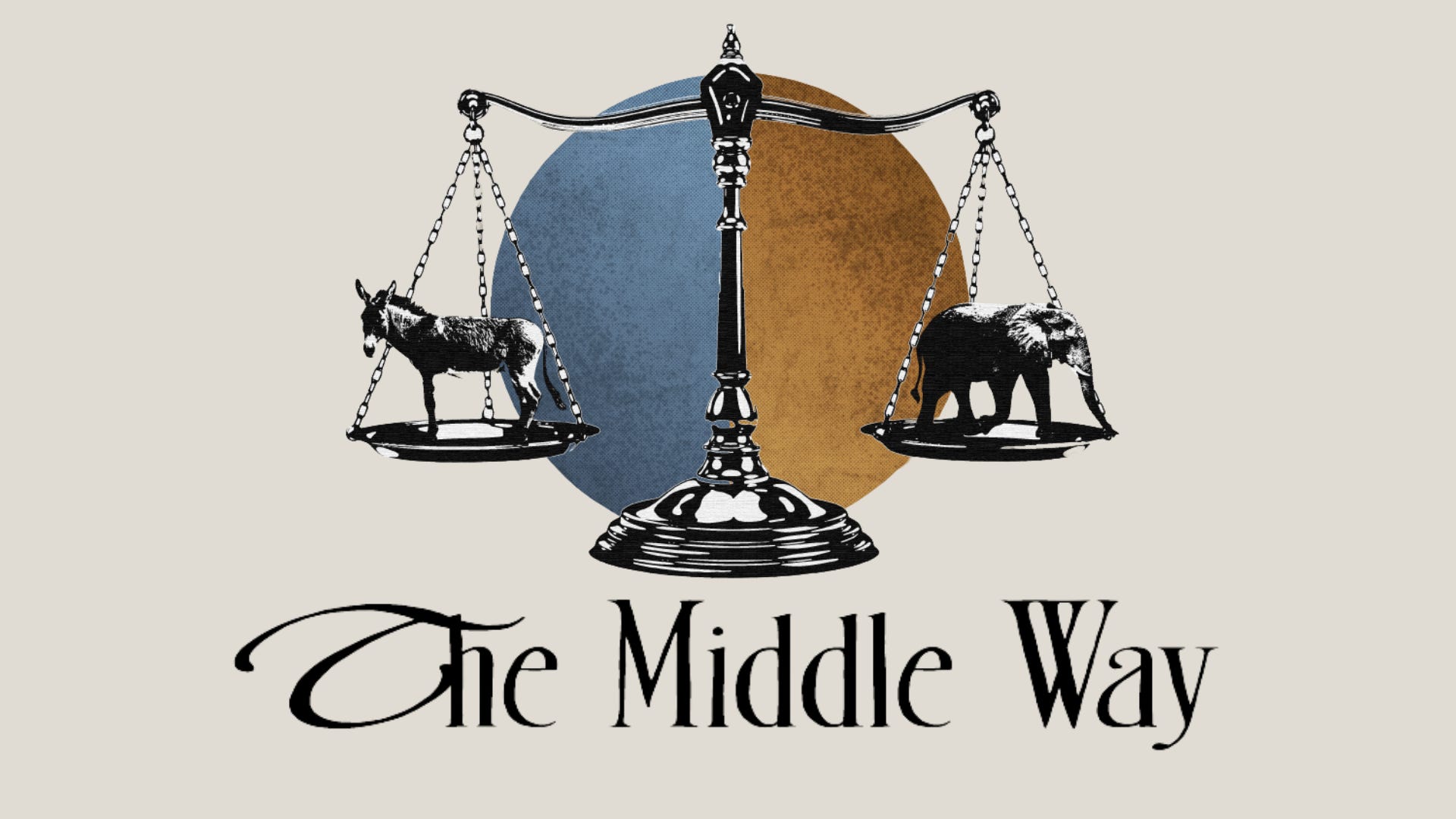
Somewhere between the two sides is where you actually live, and nobody’s built a home for that.
My political instincts are an outgrowth of my spiritual leanings: I am a fledgling Buddhist. A core philosophy of Buddhism is Madhyamaka, translated as “the middle way.” For the Buddha, this meant walking the path between hedonism and asceticism. More broadly, it can be understood as the avoidance of extremes.
I’ve spent a good chunk of life exploring the mechanisms of human physiology. If health can be reduced to one word, it’s this: balance. Or, the body’s ability to foster equilibrium. In biology, we call this precarious state homeostasis. The body is remarkably designed to cultivate balance from blood sugar to hormones, from acidity to energy.
Healthy systems cluster toward the middle.
In ecology, the healthiest systems demonstrate a balance between species. We call this biodiversity. In economics, the most thriving countries boast a strong “middle” class with a wealth distribution that looks like a bell curve, not two spikes at the ends. In psychology, we seek centeredness – an ability to bounce back to a state of equipoise.
Politics is not exempt from this equation. The body politic resembles the human body. When pushed to the extremes, it becomes unstable, sometimes diseased. It’s characterized by chaos, and an inability to cooperate, listen, and find common ground.
Our politics resembles a frayed shoelace: bunched at the ends, an ever-thinning thread holding the extremes together. Our information sandbox only exacerbates polarization as it algorithmically preferences extremism and hyperbole. Social media is designed to tickle human negativity bias and keep people in a permanent state of amygdala hijack. It erodes critical thinking and devalues nuance. And the loudest voices in the room are exceptional at pulling its levels.
But the truth is almost always in the grey zone, in the middle.
So, I’m launching the Middle Way here as a means of untangling complex issues with rigor and nuance. I want to give voice to the people who don’t succumb to the perverse incentives of compulsory contrarianism and sensationalism. There are more of us out there than we think. In fact, 45% of Americans now identify as politically independent.
What you’ll get:
Regular essays and musings that hold two simultaneous thoughts.
A willingness to be critical of “both sides” when called for.
Rigorous research.
Self-correction when appropriate.
Note: At my core, I’m a progressive. I believe in public service and that the government has a role to play in dulling the sharper edges of capitalism. I generally vote Democrat. I want to be honest about that. But that doesn’t mean I cannot think independently or call out injustice where it exists.
Subscribe free and it comes to your inbox every week. Go paid for the longer essays and the parts of this I’m still working out in real time.
There’s a strong middle in this country somewhere. I think we find it together, one week at a time.
If this is the first Middle Way essay you’re reading
This one lives in a section of my Substack called The Middle Way. It’s not the newsletter you’re used to getting from me. It’s a weekly case for the political middle, built on the same instincts I write about everywhere else, biology, philosophy, the body’s habit of correcting itself when it drifts too far in one direction. Politics isn’t exempt from that.
If you’re new here, subscribing gets you everything, including this. If you already get my Tuesday emails, go to your account settings, find The Middle Way, and choose what sections you’d like in your inbox. Takes about ten seconds.
Everything in this series so far is below. If this made you think of someone who’s also trying to find steadier ground, send it to them.
Want to Go Deeper Into Your Mind-Body Alignment?
If today’s essay resonated, you’ll love my Cultivating Inner Peace course—available to all paid Substack subscribers. 10 powerfully simple meditations for navigating turbulent times.
👉 Become a paid subscriber to unlock the course and more.
If you’re already a paid subscriber, you can start the course!
My Writing & AI
I want to apply Windex to how I use AI as part of my writing process.
When I’m scrawling my personal essays about parenthood, love or grief, I shun Uncle Claude. Those pieces come directly from/through me.
When I’m tackling subjects that require extensive research, I use AI as an assistant to synthesize scientific literature and organize information more efficiently. I also often dictate concepts into my phone and use AI to transmute those spoken thoughts into clean prose.
The ideas, arguments, opinions, and conclusions are my own. Every piece is edited by me before publication. AI doesn’t replace my thinking. It accelerates parts of the process that are mechanical rather than creative.